Duolingo, AI Chat, or Anki? The Biggest Mistake Adults Make Learning a Foreign Language is ‘Playing Childish’
The Foreword: Our Familiar English Learning Hurts Us Most
According to the EF Education First English Proficiency Index for 2025 (The world’s largest ranking of countries and regions by English skills), China ranks 86th out of 123 countries. The painful truth: only 0.9% of the population can communicate fluently in English.
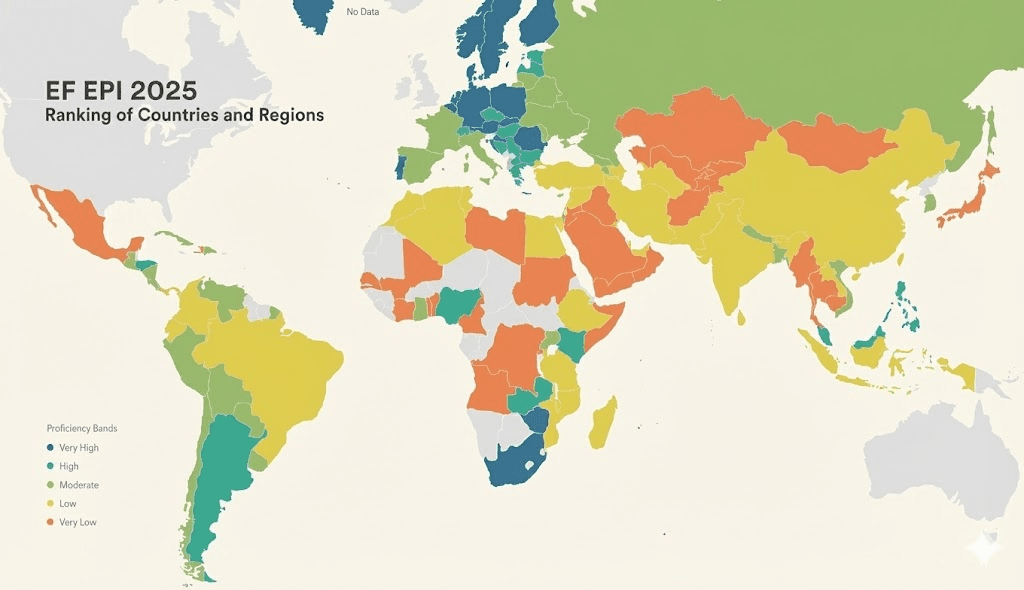
Absurd, isn’t it? From elementary school to university, we spent nearly two decades grinding away at English. We memorized piles of vocabulary and drilled countless grammar exercises, yet when it came to speaking, our minds remained a blank slate.
To escape “mute English,” we’ve tried everything: daily streaks on Duolingo, awkward AI conversations, or religiously re-watching Friends 100 times. But the outcome is often the same: enthusiasm starts with a check-in, only to end in abandonment.
Please remember: this isn’t your fault, nor is it a reflection of your willpower. It’s because the methods you chose were fundamentally flawed. A truly effective learning system should adhere to two principles (which I detailed in The First Step is Always the Hardest (and Simplest): Brain Science to End Futile Efforts): first, reduce difficulty; second, codify steps.
The underlying logic is the “Dao,” the philosophy. I also recommended the “Shu,” the method: Supercharging Your Brain: From SuperMemo to Anki – How Algorithms Can End the ‘Learn-and-Forget’ Cycle. Today, using English learning as our context, let’s explore how to build a truly painless, sustainable learning system with Anki and AI. This method is equally effective for anyone starting a second foreign language from scratch.
1. Pitfall Guide: Why Do Seemingly Great Methods Lead to Repeated Failure?
1.1 The “Duolingo” Model: Adults Shouldn’t Try to Imitate Babies
The natural immersion method, championed by apps like Duolingo, aims for “natural acquisition” like a baby. It avoids grammar explanations, skips explicit vocabulary memorization, and focuses on building connections through visuals and audio. But this is precisely the trap for adults.
- Physiological Mismatch: Babies have a golden period for language acquisition, with developing neural pathways. Adult brains, however, are already hardwired, making forced imitation of infants a high-effort, low-reward endeavor.
- Self-Sabotage: An adult’s greatest advantage in learning a foreign language is their already mature native language logic and comprehension. Completely abandoning native language support for forced “immersion” is like a martial arts master intentionally crippling themselves to relearn crawling. It’s incredibly inefficient.
- Missing Review Mechanism: These apps are designed to make you feel good, often keeping you comfortably in your shallow end. You’ll find yourself doing endless simple matching games, lacking scientific spaced repetition algorithms. You learn, forget, relearn, and perpetually stay at the beginner level. Its gamified learning approach is like a “konjac snack”—it fills you up and makes you feel satisfied, but offers no real nutritional value.
1.2 Open-Ended AI Conversations: The Unbearable “Cognitive Load”
It’s fashionable now to chat with ChatGPT or an AI language partner for speaking practice. Theoretically, AI won’t judge you, creating a safe environment. In reality, however, this practice is extremely difficult to sustain because of the excessive cognitive load:
Your native language thought process might be at a university level, aiming to express profound, humorous, or complex ideas. Yet, your foreign language expressive ability might be only at an elementary level.
When you try to convey university-level thoughts using elementary-level tools, the immense gap will cause you to stumble instantly. You won’t know what to talk about, or you’ll be stuck with the perennial time-travel drama cliché: “I am fine, thank you.”
While the AI won’t judge you, you’ll judge the clumsy, inarticulate version of yourself. This intense sense of frustration will instinctively make you avoid the next practice session.
1.3 “Shadowing” and Mechanical Repetition: Tactical Diligence, Strategic Laziness
Another extreme, “ascetic” practice involves watching a movie—like Friends or The Big Bang Theory—100 times until you can recite it. This “shadowing” method is highly touted on platforms like Xiaohongshu.
This method certainly achieves “repetition,” but it’s inefficient over-repetition.
Within a single movie, there are phrases like “How are you” that you understand instantly, alongside rapidly spoken, slang-filled difficult sentences. In mechanical repetition, you’re forced to reread that simple sentence you already know 100 times.
This is a time black hole. Such indiscriminate mechanical repetition often only serves to impress oneself, while actual efficiency is very low. Moreover, this tedious and redundant repetition simultaneously consumes a massive amount of willpower, making it incredibly difficult to sustain. The imperative for learning new knowledge: do not expend limited energy fighting against your willpower.
2. Core Methodology: Anki + AI + Engaging Content
If the above methods don’t work, how should adults learn? For adults learning English, the core logic boils down to one sentence: always stay in your $i+1$ zone ($i$ represents your mastered content, and $+1$ is slightly above your current level of new knowledge).
We need a system that only focuses on what you don’t know, yet makes you feel completely in control. This is the “Anki + Large Language Model + Podcast” closed-loop method I’m currently practicing.
2.1 Content Curation: Interest is the Best Teacher
Ditch the boring textbooks! Actively choose content that genuinely interests you. I enjoy listening to various expert interviews (like Dwarkesh Patel’s podcast).

Because I’m familiar with the background knowledge, it significantly lowers the comprehension barrier, allowing me to focus on the language itself. Even if an episode is an hour and a half long, I can listen with rapt attention.
2.2 AI Extraction: Let Gemini Be Your Private Tutor
Once you have the material, don’t just dive in blindly. Feed the transcript to an AI (like Gemini) and give it clear instructions:
“Please extract about 60 segments, each 3-4 sentences long. The criteria for selection should be: segments containing idiomatic expressions (phrases or fixed collocations) commonly used by native speakers but unfamiliar to non-native speakers.”
We’re not trying to learn obscure words (you can look those up in a dictionary). We want to learn those idiomatic chunks where “you know every single word, but put together, you have no idea how to use them.”
2.3 Card Creation Strategy: Cloze Deletion in Context
Turn the AI-extracted content into Anki cards:
- Front: The complete 3-4 sentence English passage, with the target phrase “clozed out”. Include a brief native language hint nearby (note: not a full sentence translation, just a hint for the phrase’s meaning).
- Back: Reveal the answer and simultaneously play the original audio of that segment.
The image below shows a self-made Anki card. The left image is what you see when reviewing: the content in square brackets forces recall, with Chinese hints alongside. The right image appears after you click “Show Answer.” It also plays the English audio for the text. This card has two cloze deletions. In other words, these two will appear as blanks sequentially, prompting your recall.

The second Chinese paragraph is a free translation (意译) for better understanding. The third Chinese paragraph is a literal translation (直译) of the English.
2.4 Practice Loop: From Input to Muscle Memory
- Active Recall: Look at the cloze-deleted sentence, combine it with the context and native language hint, and mentally search for that idiomatic expression.
- Audio Check: Click to reveal the answer and listen to the original audio.
- Loud Shadowing: Once confirmed, loudly repeat the entire passage 3-4 times. This step is crucial; it converts your momentary memory into oral muscle memory and auditory reflexive recognition.
Example: If you’ve read The Three-Body Problem, you might remember the concept of “Conceptual Imprint” (思想钢印). How would you express that in English? The card above shows “Conceptual Imprint”—quite vivid, and now you’ve remembered it, right?
Through this practice process, you’re simultaneously engaging in listening, speaking, reading, and writing. If you practice just 5 such cards daily, with content customized to your interests and difficulty level, would you find it hard? Anki will remind you to review just before you forget. After a month, you’ll have mastered 150 idiomatic English expressions. What if you stick with it for a year? Do you still doubt its effectiveness?
3. Where to Find Learning Materials
Don’t be intimidated by the example card—reinforcement learning is just my interest. You can completely customize your own cards. Here are some podcasts where you can directly get transcripts. These podcasts offer an inexhaustible supply of learning content.
3.1 Freakonomics

Features: Economics + Storytelling Why I Recommend It: Rigorous logic, highly engaging.
3.2 Planet Money

Features: Easy-going Economics Why I Recommend It: Moderate pace, explains complex concepts with engaging stories (e.g., they actually bought a barrel of oil to explain oil trading).
3.3 Hidden Brain

Features: Behavioral Science + Psychology Why I Recommend It: Explores how the subconscious drives human behavior, judgment, and relationships. Host Shankar Vedantam’s pronunciation is clear and elegant, and his word choice is extremely precise.
3.4 This American Life

Features: Top-tier Narrative + Social Observation Why I Recommend It: The originator of American narrative journalism. Uses small stories to convey big truths.
3.5 TED Radio Hour

Features: Innovation + Interdisciplinary Why I Recommend It: Highly inspiring, covers a wide range of content.
4. For Those Struggling: Stop “Self-Attacking”
Finally, I want to address the most important point. Many people, when they can’t stick with foreign language learning, immediately resort to self-blame: “I’m too lazy,” “I lack willpower,” “I’m just not good at languages.”
Please stop this self-attack.
Inability to sustain effort is usually not a character flaw; it’s a problem with the content or difficulty.
- If there are too many new words, making it painful to read, it means the material is too difficult, and your brain is protesting.
- If the content is boring, making you feel sleepy just looking at it, it means the material is unsuitable for you, and your brain is bored.
In such cases, what you need to do is not grimly force yourself to keep studying, but to stop immediately.
Immediately downgrade, or immediately change the content.
Language learning must be built on a cycle of positive feedback. Learning is sustainable only when you feel, “This is a bit challenging, but I can handle it, and the content is quite interesting” (i.e., the $i+1$ theory).
Remember, the best learning method is always the one that feels “less effortful.”
Don’t be an ascetic; be a smart “product manager,” constantly adjusting your learning product until it perfectly fits your brain.
Today’s Interaction:
In the next article, I will provide links to download some of the Anki decks I’ve created and explain the specific usage of the Anki software in detail. If you’re interested in this, or if your friends are looking for a scientific method to improve their English, please follow my public account or share this article.
What was the biggest “turn-off moment” you encountered while learning a foreign language? Feel free to share in the comments.