Supercharging Your Brain: From SuperMemo to Anki – How Algorithms Can End the “Learn-and-Forget” Cycle
The Sisyphus Syndrome: Pushing Stones Uphill
If you look closely, you’ll notice fewer and fewer adults maintain a deep learning habit. As I discussed in Hacker Digest #7, Article 2, the way we consume information has radically shifted towards fragmentation over the past 20 years. Have we simply lost the will to learn? Beyond the issues of “overly ambitious goals” and “decision fatigue” I touched on in my previous piece, The First Step is Always the Hardest (and Simplest), there’s a more disheartening culprit: “I just can’t remember, and I forget too fast.”
Sometimes, we’re all too much like Sisyphus from Greek mythology: we painstakingly push a massive boulder up a mountain—perhaps a newly memorized vocabulary book or a dense technical manual we’ve just devoured. We believe we’ve conquered this knowledge. But the moment we let go, that boulder rolls right back down to the bottom.
A week later, the underlined sentences in the book look familiar, but we can’t recall the next line to save our lives. A month later, that formula we once recited flawlessly is utterly alien. This sense of powerlessness eventually makes us stop struggling altogether.
Whether it’s for school exams or career advancement, our biggest adversary on the learning journey isn’t (short-term) memory; it’s forgetting.
The Efficiency Trap: The Half-Life of Memory
In our quest for personal growth and professional skill acquisition, we face a core paradox: the high cost of knowledge input versus the low efficiency of memory retention.
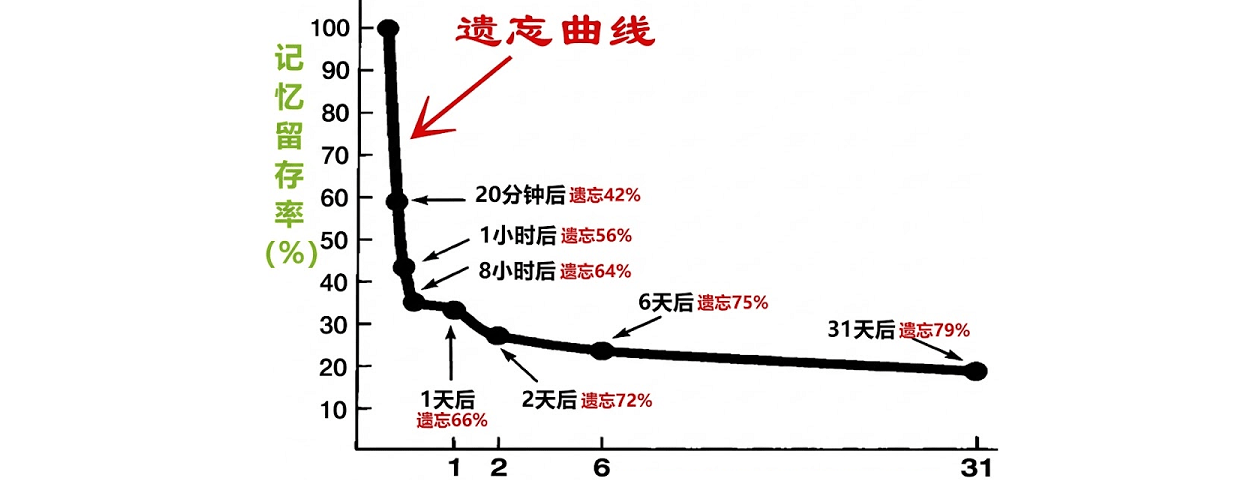
German psychologist Hermann Ebbinghaus’s “forgetting curve” brutally illustrates this physiological reality: without any review, a learner retains only 58% of new information after 20 minutes; after 24 hours, that figure plummets to 33%.

This means that most of the effort people pour into exams or certifications is, frankly, “wasted.” This abysmal return on investment often leads to despair. And in this anxiety, people typically fall into two extreme pitfalls:
- Overlearning: Repeatedly reviewing already mastered content, leading to diminishing marginal returns (e.g., already knowing “apple” but writing it 10 more times).
- Delayed Review: Waiting until knowledge is completely forgotten before relearning it, incurring massive sunk costs in time.
What if I told you there’s a precise moment when you’re “just about to forget, but haven’t forgotten yet”? What would happen if we reviewed only at that exact instant?

The Origin Story: From Pen & Paper to the SM-2 Algorithm
Pinpointing this “critical juncture” is beyond the human brain, but not beyond mathematics.
In the 1980s, Polish university student Piotr Wozniak, grappling with a demanding academic load, embarked on a years-long self-experiment. Without computer assistance, he meticulously recorded the forgetting cycles of every word, striving to quantify the decay pattern of memory.
After countless calculations, he discovered the “optimal interval algorithm.” He proved that if you review at the optimal moment, the interval for the next review can be extended exponentially (e.g., 1 day → 3 days → 7 days → 18 days…).
This discovery eventually evolved into SuperMemo and its core SM-2 algorithm—the theoretical bedrock of modern Spaced Repetition Systems (SRS). Wozniak, like a modern Prometheus stealing fire, showed us that memory isn’t magic; it’s math.
And today’s protagonist, Anki, is an open-source tool built on this very algorithm. It’s not just a simple digital flashcard box; it’s an algorithm-driven memory scheduling engine. Anki’s author, Damien Elmes, inherited SuperMemo’s soul, bringing this powerful algorithm to everyone with a more modern interface. It doesn’t create memory; it maximizes a learner’s memory efficiency by taking over the review schedule.
The Core Mechanism: How Anki Works
For first-time Anki users, understanding its underlying logic is crucial. Anki’s interaction is elegantly simple, comprising three main stages:
Active Recall
Anki doesn’t offer multiple-choice questions. Instead, it presents the question directly (the front of the card). Blue blanks in the card are cloze deletions, requiring the user to retrieve the answer from memory before flipping the card to check. A single card can have many such cloze deletions, forcing the user to recall missing information repeatedly. Neuroscientific research shows that this “effortful retrieval” process strengthens synaptic connections more effectively than passive reading.

Algorithmic Scheduling
After flipping the card, users must choose from four options based on their recall: “Again,” “Hard,” “Good,” or “Easy.”

Each option provides data to the algorithm about the user’s memory of the content. Every click you make feeds information into the algorithm. Anki then uses this feedback to automatically calculate the precise date for that card’s next appearance. You don’t need to create a review plan; the algorithm is your plan.
Quantification of Learning
Anki provides detailed statistical dashboards (like heatmaps and forgetting curves). This ability to transform an implicit cognitive process into explicit data visualizations allows learners to clearly see the “compounding effect” of knowledge accumulation.

The Crucial Mindset: Why Your Anki Might Be Failing
At this point, you might be tempted to download Anki and give it a try. Hold on.
Many people eagerly download Anki, only to uninstall it within three days. The reasons usually boil down to: “It’s too much work,” “It’s not user-friendly,” or “It’s even more painful than memorizing from a book.”
The problem usually isn’t the tool itself, but the “mindset,” specifically, the “card creation strategy.”
Piotr Wozniak once published “Twenty Rules of Formulating Knowledge,” which serves as the bible for Anki users. Two core principles dictate success or failure:
Principle 1: Minimum Information Principle
Cognitive psychology posits that the brain’s information processing bandwidth is limited. Complex cards lead to cognitive overload.
❌ Bad Card Example:
- Q: What is photosynthesis?
- A: (A lengthy, multi-paragraph definition spanning hundreds of words, including reaction equations, locations, significance…)
- Consequence: Seeing this card immediately crashes your brain, creating a sense of dread.
✅ Good Card Example:
- Q: What are the main products of photosynthesis?
- A: Sugars and oxygen.
- Core idea: Only by breaking knowledge into atomic facts can the brain easily digest it.
Principle 2: Understanding Precedes Memorization
Anki is a tool to aid memory, not a substitute for understanding. Forcefully cramming incomprehensible logic into Anki for mechanical memorization is not only inefficient but also fails to form an effective knowledge network. Spaced repetition only strengthens knowledge after it’s been understood.
Don’t try to cover up strategic laziness (lack of understanding) with tactical diligence (rote memorization). If you don’t understand a concept, don’t put it in Anki.
Application Scenarios: Building Your Personal Knowledge Base
Once you grasp “spaced repetition” and “atomic card creation,” Anki transforms from just a vocabulary tool into the second brain for lifelong learners.
- Technologists: Memorize API parameters, common error solutions, algorithm logic.
- Deep Reading: Break down golden quotes and inspirations from books into questions for long-term memory.
- Daily Life: Manage various trivial but essential information (e.g., first aid procedures, ID numbers, complex recipe ratios).
Anki’s essence is to outsource the tasks of “storage and scheduling”—which humans are notoriously bad at—to machines, thereby freeing up our brainpower to focus on higher-order cognitive activities like analysis, creation, and logical reasoning.
Conclusion: The Triumph of Long-Term Thinking
In an age obsessed with quick fixes, Anki feels out of place. It doesn’t promise “3-day mastery” or peddle “7-day expertise.”
It simply believes in the power of compound interest over time.
Using Anki represents a humble faith: a belief in the power of accumulation, and in scientific principles trumping blind effort.
Perhaps we can never truly defeat forgetting; after all, it’s a fundamental human physiological trait. But at the very least, we no longer have to hopelessly push stones uphill like Sisyphus. We can build a vehicle, equip it with an engine, and steadily transport that boulder to the summit.
From today, outsource forgetting to the algorithms, and reclaim thinking for yourself.
💡 Next Up: Anki’s initial setup can be a bit daunting. In the next article, I’ll provide a sample English learning deck and a step-by-step guide to get you started from scratch.