The First Step is Always the Hardest (and Simplest): Brain Science to End Futile Efforts
We all know the old joke: the first English word we learn is often “abandon,” because it’s at the top of every vocabulary list.

Among programmers, this well-worn meme circulates perennially:

From childhood, we’re fed narratives of “burning the midnight oil” and “no pain, no gain.” This cultural DNA is deeply embedded, leading to a profound misconception: if it’s not difficult, it’s not valuable; if it doesn’t cause suffering, it won’t yield true rewards.
However, this equation of “suffering” with “effort” is precisely why most people fail to learn new skills or cultivate a lifelong learning habit. Because, deep down, we’re wired to avoid pain.
From the perspective of neuroscience and cognitive psychology, learning is fundamentally about forging new neural connections. Pain, though, doesn’t signify connection building; it merely represents friction. Instead of building neural pathways, your mental energy dissipates like wasted heat, consumed in the internal struggle against discomfort.
If you genuinely want to master something new—be it English, programming, or a musical instrument—your first rule isn’t “work hard.” It’s to minimize cognitive load as much as possible.
Part 1: Why “High Goals” Lead to “Catastrophic Failure”

Many, when deciding to learn English, are brimming with ambition. Their plans typically look something like this:
- “I’ll memorize all GRE words in a month.”
- “I’ll read The Economist cover-to-cover, without a dictionary.”
- “I’ll listen and transcribe BBC News for an hour every day.”
These plans sound “inspirational,” but psychologically, this is a classic case of “cognitive suicide.”
According to the Yerkes-Dodson Law, the relationship between stress (task difficulty) and performance is an inverted U-curve. Moderate difficulty can spark motivation, but once it crosses a critical threshold, the brain’s amygdala (the emotional center) is activated, leading to anxiety and fear, which then suppress the prefrontal cortex responsible for logical thinking.
When, as an English beginner, you tackle a native text brimming with unfamiliar words, you’re not gaining knowledge. You’re repeatedly being battered by frustration. This relentless negative feedback can plunge you into “Learned Helplessness”—your subconscious concludes, “No matter what I do, I just can’t learn this.”
Ultimately, this escalates into severe procrastination. Procrastination isn’t about laziness; it’s about fear. It’s your brain defending itself against a colossal, painful goal.
Part 2: The Biggest Drain: The “Frontier of Choice”

Another significant source of cognitive load, often overlooked, is “choice.”
The period before learning begins is often the most willpower-draining. I call this dwelling at the “Frontier of Choice.”
Imagine this scenario: you want to learn English, but once you sit down, you start agonizing: “Should I memorize vocabulary first, or practice listening? Should I use this red book or that app? Should I study in the morning or at night?”
The psychological “Ego Depletion Theory” tells us that willpower is a finite resource, like a battery. This constant back-and-forth at the “Frontier of Choice” leads to “Decision Fatigue.” If you exhaust too much mental energy “deciding how to do it,” your battery will be drained by the time you actually start “doing it.”
This is why many people “prepare” all day, download gigabytes of resources, yet never read a single page—the classic “bad student has too many stationery” syndrome. This internal struggle is more exhausting than learning itself.
Part 3: The Scientific Approach: The “Stretch Zone” & “Codification”
Knowing the ailment, the cure becomes obvious. Effective learning must adhere to two principles: Difficulty De-escalation and Choice Codification.
1. Find Your “Stretch Zone”: Match Difficulty to Your Level

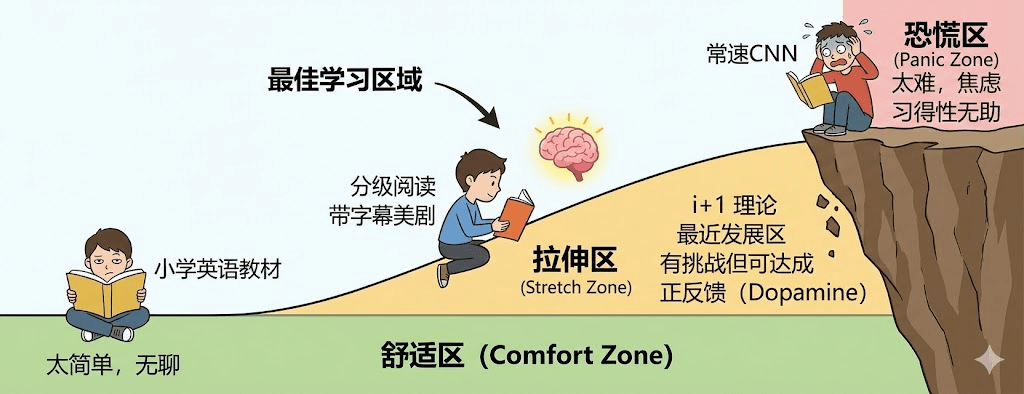
The renowned linguist Stephen Krashen proposed the "$i+1$ theory." If your current level is $i$, then the material you should be learning is $i+1$, not $i+10$. This perfectly aligns with the “Zone of Proximal Development” concept by Soviet psychologist Lev Vygotsky, later widely popularized as the classic “Comfort Zone Model”:
- Comfort Zone: Reading elementary English textbooks—too easy, boring.
- Panic Zone: Listening to fast-paced CNN news—completely incomprehensible, anxiety-inducing.
- Stretch Zone (Learning Zone): Reading graded readers, or watching Friends with English subtitles. You understand about 80%, needing to just slightly reach for the remaining 20%.
Only in the “stretch zone” do you receive positive feedback. This “I can understand this with a little effort” sense of accomplishment stimulates dopamine release in the brain—the only fuel that drives you to continue learning the next day.
Don’t be ashamed if it feels “easy.” If memorizing vocabulary is painful, start with 5 words a day, not 50. Lower the initial barrier to a point where you feel “it would be embarrassing not to do it.” That’s how you win the first step.
Many people learning new skills obsess over “Is my method the most efficient/effective?” In reality, the most effective method is the one you can stick with, no matter how simple or silly it seems. “One man’s meat is another man’s poison.” Someone else’s effective method is tailored to their cognitive level and emotional state, conditions that might not be replicable for you. A black cat or a white cat, as long as it catches mice, it’s a good cat!
2. Codify Your Choices

To avoid the internal drain at the “Frontier of Choice,” we need to “codify” our decision-making process. In psychology, this is known as “Implementation Intentions.”
What is code? Code is a logically defined set of instructions, leaving no room for negotiation. A computer doesn’t agonize, “Am I in the mood to run this program now?” It simply executes.
We need to transform our learning process into an If-Then code, turning the mental burden of this step into thoughtless, mechanical execution:
- Wrong Way (full of choices): “I’ll study English when I have time.” (When is “time”? What will I study?)
- Codified Way: “
If(I finish breakfast and put dishes in the dishwasher),Then(I immediately put on headphones and listen to 15 minutes of ESL Podcast).”
In this process, there’s no need to think “what to listen to” (the material is pre-selected), and no need to think “when to start” (the trigger condition is fixed).
What we’re doing is transforming “uncertainty” into “certainty.”
Master learners aren’t superior because they possess superhuman willpower, constantly battling their human nature. On the contrary, they leverage “codified” habits to circumvent most willpower depletion, allowing themselves to directly enter the “practice zone.”
Conclusion
Learning isn’t an ascetic pilgrimage; it’s a precise feat of mental engineering.
Only when you shed the heavy baggage of “suffering is virtue,” when you acknowledge that your brain thrives on positive feedback, detests high pressure, and fears complex choices, can you truly begin to learn.
Reducing cognitive load, lowering the difficulty to a comfortable, even “easy” level, isn’t a sign of weakness. It’s the wisdom of aligning with human nature.
After all, the most important thing is to just get started. And “getting started” isn’t about charging into battle with gritted teeth; it’s about putting on comfortable shoes and taking an easy first step. If you don’t start, how can you ever make progress?
In subsequent articles, I’ll delve into a toolkit of strategies, based on these principles of “difficulty de-escalation” and “choice codification,” that can help you effortlessly “get started.”